

Retro Aesthetic Speakers With Modern Audio Explained
Last Updated: November 6, 2026
Quick Summary
Retro aesthetic speakers with modern audio pair vintage-looking cabinets with current drivers and Bluetooth connectivity, so you get the mid-century look without accepting mid-century sound. Choose an active model with Bluetooth 5.0 or newer, and place it at least 10cm from the wall for cleaner bass.
- A wired AUX or USB connection passes an uncompressed signal, while Bluetooth compresses audio first.
- Bluetooth 5.0 or newer improves stability and range, but codec support matters more than the version number.
- An active speaker has its amplifier built in, making it the simpler choice for a desk or shelf.
- Set up a vintage system in about 30 minutes by placing the speaker at ear height and connecting your source.
- The Nebula Sky Mini Retro speaker offers Bluetooth 5.0, AUX input, and 4-6 hours of playback from a 1500mAh battery.
Table of Contents
- Why Retro Aesthetic Speakers With Modern Audio Are Worth Buying
- Bluetooth Audio Quality vs Wired: What You Actually Lose
- What to Check Before You Buy: Drivers, Cabinets, and Connectivity
- Best Vintage Style Bookshelf Speakers for Small Rooms and Home Offices
- How to Set Up a Vintage Aesthetic Audio System Step by Step
- Common Mistakes That Ruin the Sound of Retro Speakers
- Choosing Your Retro Speaker Setup at Nebula Sky
- Frequently Asked Questions
Why Retro Aesthetic Speakers With Modern Audio Are Worth Buying
Retro aesthetic speakers with modern audio solve a problem most gear guides ignore: you want a speaker that looks like it belongs on a mid-century shelf, but you refuse to accept mid-century sound. That combination is now genuinely possible, and it is why the category keeps growing.
At Nebula Sky, we curate exactly this kind of product, so we have a clear bias worth stating up front. The good news is that the engineering backs the trend. Modern drivers and Bluetooth connectivity have closed much of the gap between vintage looks and contemporary performance. What you are buying is a mood, delivered through current components.
Bluetooth Audio Quality vs Wired: What You Actually Lose
Bluetooth audio quality versus wired comes down to one trade: convenience for a small amount of fidelity. A wired connection passes an uncompressed signal straight to the speaker. Bluetooth compresses it first, then decompresses it at the other end.
How much you lose depends on the codec. Basic SBC, the default fallback, is the weakest link. AAC handles Apple devices well. Higher-bitrate codecs preserve more detail, but the source file and the speaker's own DAC matter just as much.
- Wired (AUX or USB): no compression, no pairing, no latency
- Bluetooth: compressed, but cable-free and fine for casual listening
- The real bottleneck: a low-quality master file ruins both paths equally
For more on squeezing battery life out of wireless gear, see our guide to portable speakers with long battery life.
Codecs, Latency, and When a Cable Still Wins
A cable still wins in three situations: critical listening, video work where lip-sync matters, and any setup where interference is constant. Bluetooth latency typically sits in a range you can feel during video playback, though most speakers now compensate.
What to Check Before You Buy: Drivers, Cabinets, and Connectivity
Connectivity deserves equal scrutiny, and this is where most buyers under-research. Compare these inputs and specs side by side before you commit:
- Bluetooth version and codecs: Bluetooth 5.0 or newer improves stability and range. Codec support matters more than the version number: SBC is the universal fallback, AAC works well with Apple devices, and higher-bitrate codecs preserve more detail. A speaker that supports only SBC will sound noticeably thinner with some sources.
- Wired inputs: An auxiliary input handles turntables, laptops, and older sources. USB audio can bypass the source's built-in DAC. Optical inputs suit TVs and disc players.
- Network and streaming: Wi-Fi streaming supports higher-resolution audio and multi-room setups, while Bluetooth is simpler and more portable. Decide which matters for your listening habits.
- Battery capacity: If the speaker leaves the desk, battery capacity in mAh and rated playback hours tell you more than a marketing claim. A 1500mAh battery typically delivers a few hours of playback at moderate volume.
- Physical controls: Knobs and switches beat touch panels for daily use, especially in low light.
Objective performance specs are worth reading even if you never quote them. Sensitivity (measured in dB) tells you how loud the speaker plays for a given amount of amplifier power; lower-sensitivity speakers need more power to reach the same volume. Impedance (measured in ohms) tells you whether an amplifier can drive the speaker comfortably. Frequency response gives a rough sense of range, though the measurement conditions matter as much as the numbers.
Active vs Passive: Which One Fits Your Desk or Shelf
An active speaker has an amplifier built in. Plug it in, pair it, done. A passive speaker needs an external amplifier or receiver, which adds cost and clutter but gives you upgrade paths and often better long-term serviceability.
For a desk or shelf, active wins almost every time. Fewer boxes, fewer cables, less to explain to a housemate. The trade-off is that the amplifier is matched to the driver at the factory, so you cannot upgrade one without the other. Passive speakers let you change amplification later, but you must budget for an amplifier, speaker cable, and the space to house them.
Watch out: buying a passive speaker without checking its sensitivity and impedance can leave you with a speaker your amplifier cannot drive to satisfying volume.
Here are the connectivity and spec points worth comparing side by side before you commit. For quick answers to common pre-purchase questions about specs and compatibility, see our FAQs.
| Item | What to look for | Why it matters |
|---|---|---|
| Bluetooth version | Bluetooth 5.0 or newer | Improves stability and range |
| Codecs | SBC fallback, AAC for Apple, higher-bitrate codecs | SBC-only speakers sound noticeably thinner |
| Wired inputs | AUX, USB audio, optical | Handles turntables, laptops, TVs, disc players |
| Network and streaming | Wi-Fi for hi-res and multi-room, Bluetooth for portability | Match to your listening habits |
| Battery capacity | mAh and rated playback hours | 1500mAh typically gives a few hours at moderate volume |
| Physical controls | Knobs and switches over touch panels | Better for daily use, especially in low light |
| Sensitivity | Measured in dB | Lower sensitivity needs more amplifier power |
| Impedance | Measured in ohms | Tells you if an amplifier can drive it comfortably |
Best Vintage Style Bookshelf Speakers for Small Rooms and Home Offices
The best vintage style bookshelf speakers for a small room are compact active models with a sealed cabinet and a driver sized to the space. Bigger is not better in a 10-square-metre office; it is just louder at the same volume.
Judge candidates on four things: footprint, driver size, input variety, and whether the controls are physical knobs or a touch panel. Knobs beat menus for daily use.
Watch out: a speaker marketed as "bookshelf" can still be 30cm deep and swallow your entire shelf. Measure before you commit.
How to Set Up a Vintage Aesthetic Audio System Step by Step
Setting up a vintage aesthetic audio system takes about 30 minutes and four steps. Get the placement right first, because no setting rescues a speaker jammed into a corner.
- Place the speaker on a stable surface at roughly ear height when seated. For a desk setup, that means the driver aims toward your head, not your knees.
- Keep it at least 10cm from the wall to reduce boomy bass. In a small room, pulling the speaker forward by a few centimetres often cleans up low-end muddiness more than any EQ setting.
- Connect your source: Bluetooth for convenience, cable for fidelity. If you use a turntable, route it through a phono preamp unless the speaker or amplifier has one built in.
- Set volume low, play a familiar track, then adjust position before adjusting tone. Move the speaker in small increments and listen for changes in bass and stereo image.
Placement, Turntable Integration, and Room Acoustics
A turntable needs a level surface away from the speaker's own vibration. If your speaker sits on the same shelf as the turntable, isolate one of them with a dedicated isolation pad or feet. Soft furnishings absorb reflections; bare walls bounce them. Move the speaker before you buy acoustic panels, because placement solves more problems than treatment.
Room size should guide the setup. In a small office or bedroom, a compact active speaker placed near the listening position will sound fuller than a larger speaker pushed into a corner. In a larger living room, expect to move the speaker away from walls and possibly add a second speaker for stereo separation. A common pattern is that listeners blame the speaker for boomy bass when the real cause is a corner placement.
Turntable integration has its own rules. Keep the turntable on a separate surface from the speakers if possible, and check that the tonearm is balanced before playing. If the turntable and speaker share a shelf, vibration travels through the furniture and can cause feedback at higher volumes. A simple isolation pad under the turntable is often enough.
Common Mistakes That Ruin the Sound of Retro Speakers
The most common mistake is buying for the look and ignoring the room. A beautiful cabinet in a hard, empty corner will sound worse than a plain speaker placed well.
Others worth avoiding:
- Pushing the speaker into a bookshelf with no breathing room
- Running Bluetooth at maximum volume, where distortion climbs
- Pairing a passive speaker with an underpowered amplifier
- Judging sound in a shop instead of your own room
A common mistake is treating the retro grille as removable decoration. On most models it is acoustically transparent by design; leave it alone.
Choosing Your Retro Speaker Setup at Nebula Sky
Matching a speaker to your space matters more than matching it to a spec sheet. That is the whole argument of this guide: retro styling is the easy part, and the engineering underneath is what you actually live with.
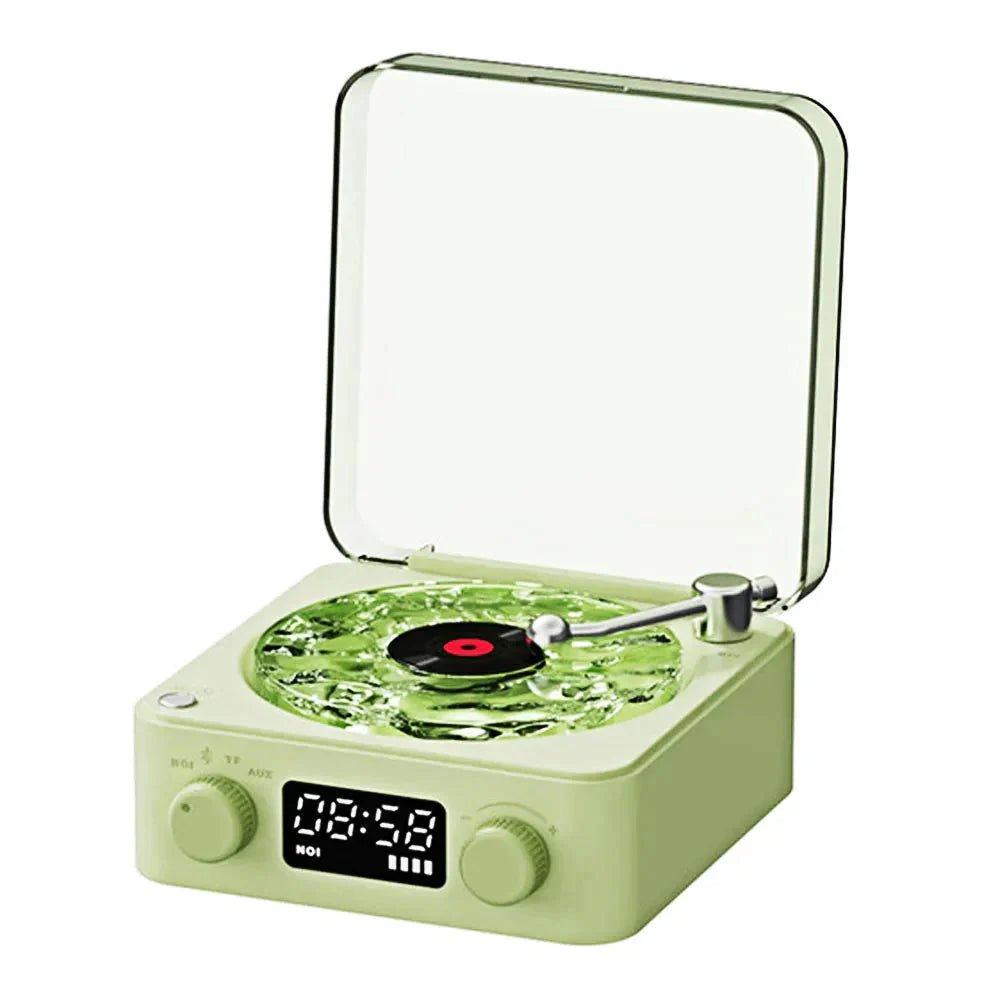
Our Mini Retro White Noise Bluetooth Speaker is built for exactly this brief. It pairs a vintage-inspired body with Bluetooth 5.0, AUX input, and 360-degree surround sound, plus four built-in nature sounds and RGB ambient lighting. A 1500mAh battery delivers 4-6 hours of playback, and it recharges in 2-3 hours over USB. It measures 5.6 x 6 x 2.64 inches, so it fits a bedside table or a hiking pack without negotiation.

Before you order, check our shipping policy for timelines and our return policy for terms. Customers like Sarah L. call it "well-designed, reliable, and perfect for everyday use," which is the standard we aim for.
The challenge is simple: find a speaker that looks the way you want and sounds the way you need. Nebula Sky builds for that overlap, with nostalgic design, multifunctional playback across home and outdoor settings, and clear audio backed by responsive support. Get started with Nebula Sky and put a speaker on your shelf that earns its place twice.
Frequently Asked Questions
Do retro-style speakers sound as good as modern speakers?
They can. The look and the sound are separate decisions. What matters is the parts inside, such as the driver and the Bluetooth version. The Mini Retro White Noise Bluetooth Speaker, with Bluetooth 5.0 and a 1500mAh battery, gives you 4-6 hours of playtime and 360-degree surround sound.
Is Bluetooth audio quality vs wired a real difference I should worry about?
For most listening, Bluetooth is fine. Wired connections avoid compression and latency, so they suit critical listening, vinyl, and video where lip-sync matters. Bluetooth 5.0 handles everyday streaming, podcasts, and background music well. If you plan to connect a turntable or watch films on the same setup, keep at least one wired input such as AUX available so you can switch when precision matters.
How do I set up a vintage aesthetic audio system without spending a fortune?
Start with one good speaker and build outward. Place it on a stable surface at ear height, keep it away from corners to reduce boomy bass, and add a turntable or streaming source later. A compact unit with Bluetooth 5.0, AUX, and TF card support covers most sources on its own. Add a second speaker only when you want true stereo separation, and buy the cables and stands after you have heard the first setup in your room.
What should I look for in the best vintage style bookshelf speakers?
Check four things: driver size and cabinet material, connectivity options, physical controls, and warranty support. Real wood or dense cabinet material reduces vibration. Bluetooth 5.0 plus AUX and card input gives you flexibility. Knobs for volume and mode are easier to use than touch panels, especially with wet or cold hands outdoors. Confirm the battery life and charging time before you buy, since a 1500mAh battery typically delivers 4-6 hours and recharges in 2-3 hours.
