

Are Bluetooth Headphones Good for Commuting?
Last Updated: November 7, 2026
Quick Summary
The best Bluetooth headphones for commuting reduce engine drone without cutting you off from platform announcements, stay comfortable for a 45-minute ride, and still have charge on the way home. Choose commuting headphones for noise reduction that targets low, constant sound, a fit that survives movement, and battery life measured in round trips rather than hours on a desk.
- Check how the headband folds before you check the frequency response, since hinges fail first.
- ANC works best on steady low-frequency noise like engine rumble and poorly on sudden sounds like chimes.
- Test each pair on the same bus, train, and street walk at the same time of day.
- Over-ear models suit long train and flight commutes; earbuds suit short trips and light packing.
- Plan for a real-world battery figure noticeably below the advertised one.
Table of Contents
- What Actually Matters in Commuting Headphones
- Best Travel Headphones: What Separates Them From Desk Models
- Best Headphones for Travel Noise Cancelling: What ANC Can and Cannot Do
- Over-Ear vs In-Ear Headphones for Commuting
- Bluetooth Headphone Battery Life: How Much You Really Need
- Safety, Fit and Connectivity on the Move
- Frequently Asked Questions
What Actually Matters in Commuting Headphones
The best Bluetooth headphones for commuting are not the ones with the longest spec sheet. They are the pair that reduces engine drone without cutting you off from the platform announcement, stays comfortable for a 45-minute ride, and still has charge on the way home. This trade-off is worth thinking about carefully, because much buying advice ignores it.
Three things decide whether a pair works on a commute: noise reduction that targets low, constant sound rather than everything; a fit that survives movement; and battery life measured in round trips, not hours on a desk. Sound quality matters, but it ranks below those three for most commuters. A pair with brilliant audio and a loose fit is a pair you will stop wearing by week two.
Below, we break down what separates commuting headphones from desk models, what noise cancelling genuinely fixes, and how to choose without overpaying.
Best Travel Headphones: What Separates Them From Desk Models
Travel headphones are built around movement, not around a listening chair. That single difference drives every design decision that matters. Desk models optimise for weight distribution and open sound; travel models optimise for clamping force that holds through a train jolt, a foldable hinge that survives a bag, and controls you can find without looking.
Portability is where the gap shows first. A folding design and a hard carrying case sound like small details until you are stuffing a bag under a seat. Weight matters too: anything that feels fine for an hour at a desk can feel heavy by the third stop.
The practical checklist we would use:
- Folds flat or into a case so it survives a carry-on
- Controls on the earcup, not on a cable, so you can adjust without removing a glove
- Splash resistance for rain and platform drizzle
- Bluetooth multipoint so the laptop and phone stay connected at once
- A case that actually protects the hinges, since that is the part that fails first
What most guides miss is that durability is a hinge and cable problem, not a driver problem. Check how the headband folds before you check the frequency response.
Best Headphones for Travel Noise Cancelling: What ANC Can and Cannot Do
Active noise cancellation is the technology that samples outside sound with microphones and plays an inverted signal to cancel it. It works best on steady, low-frequency noise: engine rumble, air conditioning hum, the drone of a plane cabin. It works poorly on sudden or high-frequency sound: a baby crying, a station chime, a colleague talking beside you. That distinction changes how you should shop.
A repeatable commute test is the only way to know whether a pair actually works for your route. First, noise reduction, how much of the engine drone disappears at full ANC, and whether a low-frequency hum remains. Second, comfort, whether the clamping force or ear tip pressure becomes noticeable before the end of the ride. Third, awareness, whether transparency mode lets you hear a platform announcement clearly without removing the headphones.
Set expectations by commute type. On a bus or coach, low-frequency engine noise dominates, and strong ANC earns its price. On a train, the loudest sounds are often mid-frequency rail screech and door chimes, which ANC handles less well, passive isolation from a good seal does more of the work.
Transparency mode is the other half of the story. It pipes outside sound back in so you can hear announcements without removing the headphones. For commuters, this is not a bonus feature, it is a safety feature. Look for one-tap switching, not a buried menu setting, and check whether the transparency mode sounds natural or harsh, a poor implementation amplifies wind and makes you want to switch it off.
Watch out: no pair cancels a train announcement, and none should. The goal is reducing fatigue, not silence, and a pair that claims to block everything is either exaggerating or unsafe for platform use.
Over-Ear vs In-Ear Headphones for Commuting
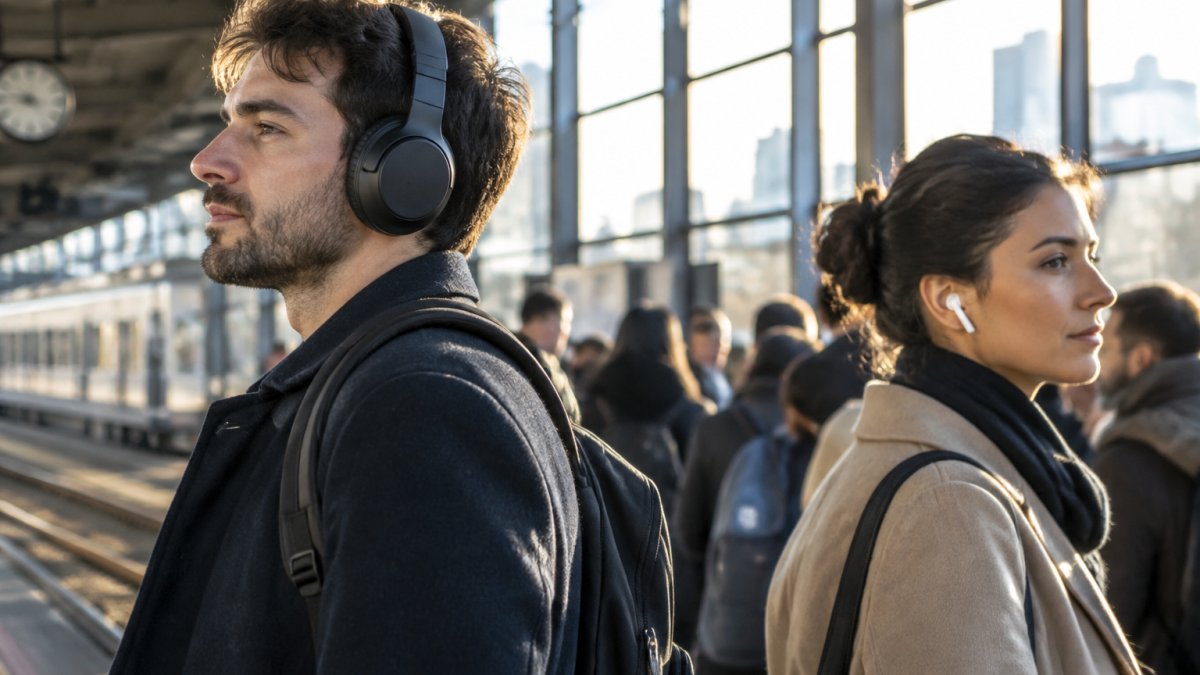
The choice between over-ear headphones and wireless earbuds comes down to what you are willing to carry and what you are willing to feel. Over-ear models generally deliver stronger noise isolation, longer battery life, and larger controls. Wireless earbuds win on portability, packing into a pocket and disappearing into a bag.
Comfort over long listening sessions is the deciding factor people underestimate. Over-ear clamping force can cause pressure at the temples after a couple of hours; earbuds can irritate the ear canal if the ear tips are the wrong size. Neither is universally better. It depends on your head, your ears, and how long you sit still.
| Factor | Over-Ear | Wireless Earbuds |
|---|---|---|
| Noise isolation | Stronger seal, more passive blocking | Depends on ear tip fit |
| Battery life | Longer per charge | Shorter, plus case top-ups |
| Portability | Needs a case or bag space | Fits in a pocket |
| Comfort | Pressure points after hours | Ear canal fatigue if tips fit poorly |
| Controls | Larger, easier to find | Small touch zones |
| Best for | Long train and flight commutes | Short trips, light packing |
Best for: over-ear if your commute is long and you carry a bag. Skip if: you travel light and hate carrying a case.
Bluetooth Headphone Battery Life: How Much You Really Need
Battery life on commuting headphones should be measured in round trips, not in a lab number. A 30-hour rating sounds generous until you account for cold weather, volume, and noise cancelling, all of which draw more power. Plan for a real-world figure noticeably below the advertised one.
Plan for a pair that covers several round trips on one charge, then charge regularly. That buffer absorbs the days you forget. Charging time matters as much as capacity, because a fast top-up before you leave the house rescues more mornings than a big battery does.
If battery life is your main concern and you want a deeper comparison of long-runtime portable audio, our guide on how to choose portable speakers with long battery life in 2026 covers the same trade-offs in more detail.
Safety, Fit and Connectivity on the Move
Safety comes before sound. Situational awareness in public is not a nice-to-have, and full noise isolation on a platform or at a crossing is a genuine risk. The practical rule most commuters settle on is simple: use transparency mode or adjustable ANC near traffic, keep one earbud out if you are crossing a street, and never rely on cancelling to keep you alert.
Fit and stability decide whether you actually keep wearing the headphones. Ear tips in the wrong size leak bass and slip during movement; a loose headband means constant readjustment. Try the smaller and larger tips before deciding the pair is uncomfortable.
Accessibility and inclusive fit are rarely covered in commuting guides but matter enormously. If you wear glasses, over-ear pads that press the arms of your frames against your head will become painful on a long ride; look for pads with a softer foam or a deeper cup. If you have smaller ears, many over-ear cups will feel cavernous and seal poorly, so earbuds with multiple tip sizes may be the better choice.
Connection stability is the last piece. Bluetooth multipoint lets a phone and a laptop stay paired at once, so a call does not mean re-pairing. The mechanism matters: true multipoint maintains two active connections simultaneously, while some budget models only remember paired devices and require you to disconnect one before connecting the other.
If you have questions about fit, pairing, or connectivity before you buy, the Nebula Sky FAQs cover the practical answers.
The Bluetooth Sleep Headband is built for comfort rather than commuting: soft, breathable fabric, built-in HD stereo speakers, and up to 10 hours of continuous playtime. It suits overnight listening and relaxation rather than platform announcements.
Frequently Asked Questions
Are noise-cancelling headphones worth it for commuting?
Active noise cancellation is the single biggest upgrade for bus, train and airplane commutes because it targets the steady low-frequency rumble that passive isolation struggles with. It will not remove voices, announcements or sudden clatter, so pair ANC with a good physical seal. If you mostly walk or cycle in traffic, weigh that benefit against the awareness you lose, and use transparency mode where you need to hear your surroundings.
Are over-ear or in-ear headphones better for commuting?
Over-ear headphones usually win on comfort for long listening sessions and on passive isolation, but they are bulkier and warmer in summer. In-ear models pack smaller, stay stable while moving and often cost less, though fit depends heavily on ear tips. If your commute is over an hour each way, over-ear tends to be the more comfortable choice; for short, crowded trips or workouts, in-ear is easier to live with.
How much battery life do commuter headphones need?
Add up your daily listening time and multiply by the days between charges you want. A 40-minute round trip uses under an hour a day, so even modest battery life covers a week. Frequent flyers and long-haul travellers should look for longer playtime plus fast charging, since a short top-up before a flight matters more than a big number on the box. Check charging time as well as playtime.
Are Bluetooth headphones safe to wear while walking in traffic?
They are safe if you stay aware. Heavy noise cancellation and high volume cut the sound of approaching vehicles, so keep volume moderate and use transparency or ambient sound mode at crossings. On foot, in-ear models that let some sound through can be the safer pick. Never wear both earbuds at high volume near roads, and check local rules before cycling with headphones on.
